Risk Management · 2025
In this section2 topics
Risk Management Policy & Plan
Policy & Plan Description
Risk Management
Risk Management Policy and Plan
The Company has established a risk management policy and framework covering all key dimensions, including strategic, operational, financial, legal compliance, and corporate ethics risks. The framework is designed to align with the Company’s vision, objectives, and business strategies, as well as relevant laws, regulations, and requirements. This enables effective risk assessment and impact analysis, with clearly defined preventive and corrective measures and assigned responsibilities.
The Company has implemented a continuous risk monitoring and reporting system. The Head of the Legal Department, who serves as Secretary to the Risk Management Committee, is responsible for consolidating, analyzing, and reporting quarterly risk assessment results to the Managing Director, the Risk Management Committee, and the Board of Directors, ensuring comprehensive risk oversight in accordance with good corporate governance principles. At the Board of Directors’ Meeting No. 5/2025 held on 13 November 2025, the Board reviewed, revised, and approved the Company’s risk management policy, and continuously monitored and reviewed the risk management performance for the year 2025, to support the achievement of the Company’s objectives and sustainable business operations.
1. All executives and employees have a responsibility to manage risks within their workplaces by adhering to the corporate risk management policy and enhancing the policy to improve their chances for success and minimize potential impacts.
2. The Company's management will organize its risk management by analyzing the linkages between every factor that affects the company, while ensuring that proper steps are taken to ensure success according to the company's goals.
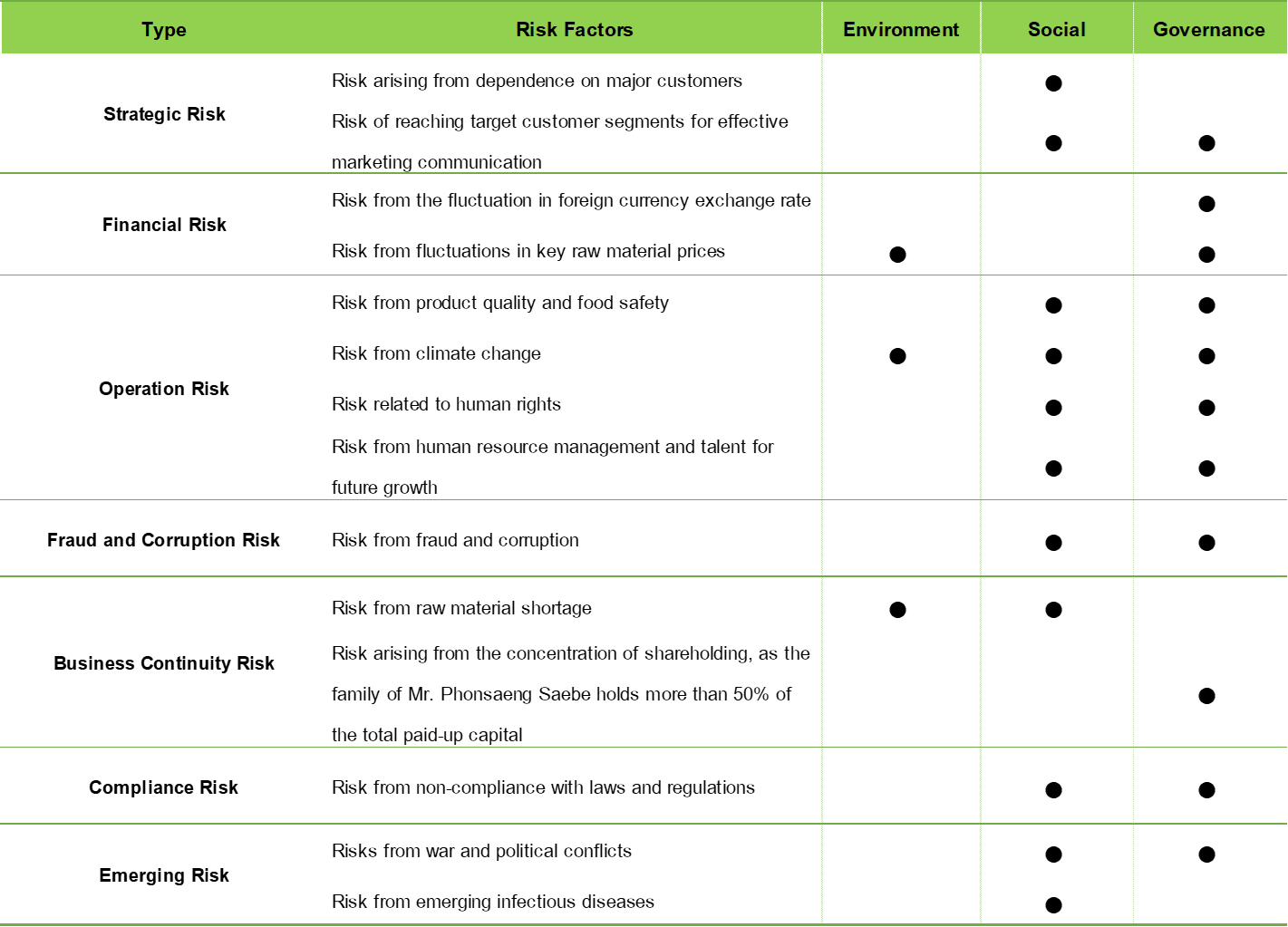
3. The Company will evaluate its risks by considering every factor, both inside and outside the Company. These risks are divided into 7 categories, namely 1) strategic risk, 2) financial risk, 3) operational risk, 4) fraud and corruption risk, 5) business continuity risk 6) legal and corporate compliance risk, and 7) emerging risk.
4.To determine the acceptable risk profile of the organization's significant risks, and to promote effective risk management tools, manuals, and processes that are appropriate for changes in business operations, as well as continuous reporting of risk management performance to the Board of Directors.
5.Designating the corporate risk management mechanism that meets international standards, while formulating the acceptable strategic risk level to be used as criteria for the selection of appropriate business strategies that align with the company's objectives and risk management operations and directions.
6.Supporting and fostering the appropriate mindset that highlights the importance of risk management and encourages its proper implementation.
Risk Management Plan
Category of Risk divided into 7 groups as follows:
1) Strategic Risk: Strategic Risk refers to risks arising from inappropriate or ineffective formulation or implementation of strategies and operational plans that are not aligned with internal factors or external environments, which may adversely affect the achievement of the Company’s vision, mission, or organizational position.
2) Financial Risk: Financial Risk refers to risks that may impact the Company’s operating performance and financial position, such as fluctuations in foreign exchange rates, changes in borrowing interest rates, volatility of fresh raw material prices, and delays in shipment departures not occurring within the specified timeframe (within 60 days from the date products leave the factory).
3) Operation Risk: Operational Risk refers to risks of loss resulting from inadequate or ineffective internal controls, covering factors related to processes, equipment, personnel, information systems, cybersecurity, data protection, and risks arising from the selection of technology that is incompatible with existing systems or unable to support future business growth.
4) Fraud and Corruption Risk: Fraud and Corruption Risk refers to risks arising from acts intended to obtain undue or unlawful benefits for oneself or others. This includes embezzlement, falsification of accounting records, and corruption involving public or private sector officials or related parties, whether directly or indirectly, to induce actions or omissions in order to obtain or retain business or other improper business advantages.
5) Business Continuity Risk: Business Continuity Risk refers to risks arising from events that may cause business disruptions, whether for a short period or an extended duration, resulting in the Company’s inability to continue its operations.
6) Legal and Compliance Risk: Legal and Compliance Risk refers to risks arising from non-compliance with applicable laws, rules, regulations, or requirements of relevant authorities or organizations, which may affect the Company’s operations, as well as risks arising from changes in such laws and regulations.
7) Emerging Risk: Emerging Risk refers to external risks that are expected or likely to have long-term impacts over a period of three to five years on the industry or business sector. These risks are difficult to predict on an ongoing basis and include geopolitical conflicts, political uncertainty and unrest, severe macroeconomic volatility, natural disasters, terrorism, cyberattacks, pandemics, and supply chain disruptions.
Risk management structure is divided into 3 stages, as follows
1) Risk Management Committee: determine policy, strategy, guidelines, and risk management structure revision that contributes to the Company’s efficient operation that coincides with the international standard. The Committee will also provide suggestions to improve the Company’s operation and direction, while carrying out the annual risk evaluation and reporting the result to the Board of Directors.
2) Executive Committee: regulate the implementation of risk management plan inside the Company, gauge and follow up on the implementation, while supporting the improvement of the plan Company-wide, with the result being reported to the Risk Management Committee. Moreover, the Executive Committee ensures a timely report to the Risk Management Committee in urgent matters.
3) All employees: have the duty to follow the approved risk management plan and process. This must be strictly followed at the division, operation and corporate levels.
Risks to the Company's Business Operations
Risk Register
| Risk Name | Risk Characteristics | Consequences | Management Measures | Related Risk Factors |
|---|---|---|---|---|
| Risk Management | Business Operation Risk Factors
Strategic Risk (1) Risk arising from dependence on major customers The Company faces risks arising from its reliance on a major customer, as a significant portion of its revenue is derived from this customer group. Any changes in purchasing policies, order volumes, or other external factors may have a material impact on the Company’s revenue. Accordingly, the Company places importance on diversifying its customer base in order to mitigate such risks over the long term. In 2023, 2024, and 2025, revenue from sales to a major customer in the United States accounted for 43.0%, 43.7%, and 47.4% of total sales revenue, respectively. This customer is a distributor of vegetable and fruit beverages, food ingredients, and snack products in the United States, distributing its products through leading hypermarket chains, supermarkets, and various retail outlets. The primary consumer base comprises Latin American consumers. Coconut milk and coconut water are popular products among this consumer group and have also gained increasing acceptance among the general U.S. consumer market. As a result, the market continues to demonstrate growth potential. In 2025, the customer expanded its distribution channels and enhanced its collaboration with the Company by establishing a strategic partnership through the co-branding development of a new product, namely 100% coconut water in PET bottle packaging. This initiative supported an increase in sales in the U.S. market, accounting for 47.4% of total sales revenue. The Company’s risk management strategies are as follows; 1) Preserve the old customer base
2) Expand the customer base
3) Exploring JV and M&A opportunities to expand revenue sources through strategic partnerships or acquisitions (2) Risk of reaching the customer segment to communicate marketing messages. The beverage industry is highly competitive, with competition from large operators with substantial marketing budgets as well as smaller players with high operational agility. As a result, consumers have a wide range of choices, particularly in the Thai market where the Company is in the process of expanding its customer base and strengthening brand awareness. If the Company is unable to effectively reach target consumers or clearly differentiate its products and brand, this may adversely affect its competitiveness, sales performance, and long-term growth. Accordingly, the Company’s success depends on its ability to implement appropriate marketing strategies while maintaining effective cost and expense control. The Company does not compete primarily on price, but instead focuses on building competitive advantages through product quality, distinctive taste, effective responses to consumer needs, and continuous enhancement of brand positioning. Nevertheless, the Company also possesses several key strengths, including: 1) The Company has been understanding the answers and good relationships with key partners for long period time. 2) The management team has capable and experience over 14 years in the beverage industry. 3) There is an organizational culture in which middle management can access and share ideas with senior management to help plan and solve problems or initiate new plans together. 4) The Company has started to develop good relationships with several major customer partners. If successful, it will be a channel for distribution throughout the region. 5)The current size of the business has resulted in economies of scale and efficiency in such areas as procurement, transportation, and advertising. The Company has established the following risk management approaches: 1) The Company places importance on building and continuously strengthening relationships with customers through the introduction of new products tailored to customer needs, joint annual purchase and sales planning, and effective after-sales services. These initiatives aim to retain existing customers while increasing opportunities to expand the new customer base. 2) The Company develops proprietary product formulations that are distinctive and aligned with consumer preferences. Key product attributes, including taste, color, aroma, and ingredients such as coconut jelly, are owned by the Company, resulting in products that are differentiated and difficult to replicate. The sales and research and development teams work closely with customers to continuously refine and develop products that meet consumer satisfaction at acceptable price levels. 3) The Company maintains flexibility in adjusting production formulations to manage costs without compromising product quality. Leveraging its extensive industry experience, the Company is able to manage volatility in raw material prices by optimizing formulations while maintaining consistent taste. In addition, bulk procurement of raw materials and packaging enhances bargaining power, while the Company benefits from its strategic location in close proximity to high-quality coconut water sources. 4) The Company conducts ongoing marketing communications to enhance brand awareness through its official online channels, including Facebook, the Company website, Lazada, Shopee and TikTok, to communicate activities, promotions, and product-related content, thereby increasing reach to target consumers. 5) The Company has established clear brand guidelines to ensure consistent and unified communication across all channels, reflecting a strong brand identity and enhancing credibility and brand recognition in the market. 6) The Company systematically plans its marketing operations and promotional activities, including the development of modern communication formats and content designed to attract target customers and enhance overall competitiveness in the market. The Company plans to expand its customer base to new customer segments and additional international markets, with a focus on promoting the Company’s branded products alongside the launch of new products from its PET bottle production line, such as mixed fruit juice with coconut jelly under the “MABU COCO” brand and 100% coconut water under the “COCO ROYAL” brand. These initiatives are expected to significantly support future sales growth. Domestically, the Company places importance on implementing effective marketing strategies to more precisely reach target consumers. The Company has initiated marketing activities through its official online communication channels and distributes its branded products through modern trade channels, as well as expanding into online sales platforms, to enhance product accessibility and continuously broaden consumer reach. Financial Risk (1) Risk from the fluctuation in foreign currency exchange rate The majority of the Company’s sales revenue is derived from overseas markets, with more than 75% of transactions conducted in foreign currencies, while certain costs are still denominated in Thai Baht. As a result, the Company is directly exposed to foreign exchange rate fluctuation risk. Significant appreciation or depreciation of exchange rates beyond expectations may adversely affect the Company’s revenue, gross margin, price competitiveness, and financial stability. To manage such risks, the Company has established a clear foreign exchange risk management policy, with the key principle of minimizing foreign exchange exposure to an acceptable level without engaging in currency speculation (minimize FX exposure without speculation). The Company also regularly reviews and adjusts its risk management approaches to align with prevailing economic conditions and foreign exchange market situations. The Company employs a variety of foreign exchange risk management measures, including:
The primary methods adopted by the Company are items (1), (2), and (3), with appropriate hedge ratios determined in accordance with the Company’s policy and adjusted in response to economic conditions from time to time. Management closely monitors foreign exchange trends, economic developments, and movements in financial markets to support timely hedging decisions. In addition, foreign exchange rate information is taken into consideration when determining product pricing to ensure alignment with currency fluctuations. Furthermore, the Company adopts local currency diversification in both receipts and payments to reduce reliance on any single currency. This approach helps enhance financial stability and mitigate overall exposure to foreign exchange volatility. (2) Risk from the fluctuation in Key Raw Material Prices The Company’s key raw materials consist of coconut-based products, including coconut water, coconut milk, coconut meat, and coconut jelly. Prices of these raw materials are subject to fluctuations driven by market supply and demand and are influenced by external factors beyond the Company’s control, such as climate change, natural disasters, droughts, and plant disease outbreaks. During periods of significant volatility, raw material costs may increase materially, while the Company may not be able to immediately adjust selling prices to reflect higher costs. This may adversely affect the Company’s gross margin and operating performance. To manage risks arising from volatility in raw material prices, The Company has implemented the following measures:
Operation Risk (1) Risk from Product Quality and Food Safety Consumer safety is a critical factor in maintaining confidence in the Company’s products. Even minor incidents, such as product contamination, the presence of foreign objects, or expired products, may have a material adverse impact on the Company’s reputation, brand image, customer confidence, and sales performance. Accordingly, the Company places the highest priority on raw material selection and maintains strict controls and attention to detail throughout all stages of the production process. The Research and Development (R&D), Production, and Quality Control (QC) departments work closely together to mitigate and prevent such risks. The Company has obtained multiple internationally recognized quality and safety certifications, including HACCP & GHPs, GMP, FDA, HALAL, ISO 22000, FSSC 22000, Thailand Trust Mark (T Mark), and ISO 9001, reflecting the robustness and safety of its production and quality management systems. To manage and mitigate product quality and food safety risks, the Company has implemented the following measures:
(2) Risk from climate change The Company operates as a manufacturer and distributor of beverages processed from coconuts and fruits, with primary reliance on natural raw materials. Changes in climate conditions, such as droughts, irregular rainfall, storms, and seasonal volatility, may directly affect coconut and fruit yields, as well as the quantity and quality of raw materials used in production. Severe climate events may result in higher procurement costs, risks of raw material shortages, and potential disruption to production continuity. In addition, production processes in the food and beverage industry may generate greenhouse gas emissions, which are a contributing factor to climate change. The Company recognizes its role and responsibility in mitigating environmental impacts and is committed to continuously implementing measures to reduce greenhouse gas emissions and enhance environmental sustainability.
(3) Risk from human rights Currently, all sectors emphasize the human rights risks associated with business operations. The Company recognizes the significance and potential impact of these issues across the entire value chain. Therefore, it has established a clear human rights policy, which is communicated to all employees and partners to ensure operations align with international human rights standards and demonstrate responsibility toward society and all stakeholders. The Company prioritizes the promotion and protection of fundamental human rights and freedoms across various aspects, including fair and equal employment practices, the prevention of all forms of discrimination, the elimination of child labor, the protection of employees' rights and freedoms, and the safeguarding of privacy, health, and safety in the workplace. Additionally, all levels of management are responsible for monitoring and ensuring that business operations remain free from human rights violations. This includes a strict commitment to treating all employees in accordance with the Company's human rights policies and practices. The Company has also implemented monitoring, auditing, and regular evaluation processes to ensure compliance with established human rights principles and standards. The Company believes that conducting business with respect for human rights not only mitigates potential risks but also serves as a fundamental foundation for sustainability and fosters trust among all relevant stakeholders. The Company believes that conducting business with a strong commitment to respecting human rights not only helps mitigate operational and legal risks, but also serves as a fundamental foundation for building a sustainable organization and earning the trust of all stakeholders. The Company has implemented the following human rights risk management measures:
(4) Risk from Human Resource Management and Talent for Future Growth Human capital capability is a critical factor for the Company’s success. Reliance on key personnel in critical positions or shortages of skilled and specialized employees may adversely affect operational efficiency, product quality, and business continuity, particularly during periods of capacity expansion and continued business growth. If the Company is unable to retain talented employees or attract qualified new personnel in a timely manner, this may pose risks to consumer confidence and overall stakeholder trust. To manage human resource risks and support future growth, the Company has implemented the following measures:
Fraud and Corruption Risk Fraud and corruption represent significant risks that may severely affect the Company’s business operations, reputation, credibility, management effectiveness, financial performance, and the confidence of shareholders, customers, business partners, and other stakeholders. Any occurrence of fraud, whether internal misconduct, illegal acts, bribery, or non-transparent practices, may expose the Company to legal and regulatory risks, administrative penalties, litigation, reputational damage, and long-term loss of competitiveness. The Company recognizes the importance of preventing such risks and is committed to conducting its business with transparency, fairness, and strong adherence to good corporate governance principles. Accordingly, the Company has established clear anti-corruption policies and measures encompassing internal controls, governance, audit, and monitoring processes to ensure compliance with applicable laws, regulations, and relevant standards.
The Company’s fraud and corruption risk management measures include the following:
The Company’s strong commitment to anti-corruption practices is clearly demonstrated. In 2024, the Company was certified as a member of the Thai Private Sector Collective Action Against Corruption (CAC Certified). In 2025, the Company further enhanced its status by achieving CAC Change Agent Certification at the 3-Star level, affirming its role as a leading organization actively promoting anti-corruption practices and extending such principles to its business partners and related parties, in support of transparent and sustainable growth of the Thai business sector. Business Continuity Risk (1) Risk from Raw Material Shortage The Company may be exposed to risks arising from shortages of key raw materials used in its production processes, such as coconut water, coconut meat, and basil seeds. These natural raw materials may be affected by factors including climate conditions, droughts, plant diseases, fluctuations in agricultural output, and procurement competition in the market. Such shortages may lead to higher production costs, reduced production volumes, supply chain disruptions, and adverse impacts on the Company’s ability to deliver products to customers and generate revenue. However, the Company has not experienced raw material shortages in the past, as it has implemented systematic risk management measures to ensure business continuity, including the following:
(2) Risk from the fact that the family of Mr.Phonsaeng Saebe is the majority shareholder who holds over 50% of the total paid-up capital Family of Mr.Phonsaeng Saebe—consisting of Mr.Phonsaeng Saebe, Ms.Amornrat Ketvisate, Mr. Surachai Saebe, Mr.Xueduan Ma and Mrs.Nusara Ma (collectively called “the founders”) holds over 56.9% of total shares, effectively the majority shareholders who have huge impact on the policymaking of the Company. They can direct the direction of the Company’s management and have a hold over the resolution of the General Shareholders’ Meeting. Thus, other shareholders can find it difficult to accumulate enough votes to check their sway in the General Shareholders’ Meeting. However, regarding the Company’s management structure that consists of the Board of Directors and the Audit Committee, it can be concluded that the structure has clearly outlined the scope of power, duty and responsibilities of each committee, with clear policies regarding any transactions that involve major shareholders, directors, those who hold management authority or may have conflict of interest. Those persons will not be involved in the voting of such matter. Independent directors are also appointed to participate in the Board to ensure transparency and inspire confidence among shareholders that the management structure has a tangible check and balance as well as management system. Compliance Risk (1) Risk from Non-Compliance with Laws and Regulations The Company’s business operations encompass product research and development, manufacturing processes, marketing activities, and product distribution, all of which are subject to compliance with applicable laws, regulations, rules, and standards imposed by relevant authorities in both domestic and international markets. The complexity of legal requirements, changes in laws or regulatory policies, as well as ambiguous interpretations or misunderstandings in practical implementation, may adversely affect the Company’s operations. Failure to comply with such laws and regulations may result in regulatory penalties, legal sanctions, and potential negative impacts on the Company’s reputation and credibility in the long term. To prevent and mitigate such risks, the Company has implemented the following risk management measures:
Emerging Risk The Company has established a risk management plan to address potential emerging risks through a systematic process of identifying, analyzing, and assessing risk factors that may affect its future business operations. Appropriate preventive, mitigating, and preparedness measures have been defined to ensure effective response to potential incidents, thereby minimizing operational impacts and maintaining business continuity. The results of the risk assessment and the corresponding risk management plans are regularly presented and reported to the Risk Management Committee and the Board of Directors to ensure comprehensive oversight, effective monitoring, and sound corporate governance. (1) Risks from War and Political Conflicts Armed conflicts, geopolitical tensions in various regions, rising trade protectionism—including the United States’ tariff measures under the “America First” policy—and economic sanctions may have significant adverse impacts on both domestic and global economic conditions. Such factors could lead to higher production and transportation costs, increased uncertainty in business expansion and investment decisions, trade restrictions, and a decline in sales due to weakened consumer purchasing power resulting from inflationary pressures and higher import tariffs. These circumstances represent key risks that may affect the Company’s cost structure, supply chain management, price competitiveness, continuity of export operations, and long-term growth plans in international markets. To mitigate potential impacts and manage uncertainties arising from such risks, the Company has implemented the following risk management measures:
(2) Risks from Emerging and Re-emerging Diseases The emergence of new infectious diseases, mutations of existing pathogens, and the re-emergence of previously controlled diseases—such as new variants of COVID-19 or certain strains of avian influenza—represent significant risk factors that may have widespread impacts across industries. Businesses that rely heavily on human labor may face heightened risks of labor shortages, production disruptions, increased disease prevention and control costs, and potential interruptions in raw material procurement within the food supply chain. In the event of a severe outbreak, such risks may result in production slowdowns and adversely affect the Company’s ability to deliver products to customers. To mitigate potential impacts and reduce uncertainties arising from emerging disease risks, the Company has established systematic risk management measures as follows:
| - | - | 738 · Description: Reliance on employees in key positions · Info category: OPERATIONAL_RISK · 739 · Description: Shortage or reliance on skilled workers · Info category: OPERATIONAL_RISK · 740 · Description: Shortage or fluctuation in pricing of raw materials or productive resources · Info category: OPERATIONAL_RISK · 758 · Description: Violations of laws and regulations · Info category: COMPLIANCE_RISK · 764 · Description: Fluctuation in exchange rates, interest rates, or the inflation rate · Info category: FINANCIAL_RISK · 734 · Description: Reliance on large customers or few customers · Info category: STRATEGIC_RISK · 767 · Other name: Risk from the fluctuation in Key Raw Material Prices · Description: Other · Info category: FINANCIAL_RISK · 750 · Description: Climate change and disasters · Info category: OPERATIONAL_RISK · 1717 · Description: ESG risk · Info category: STRATEGIC_RISK · 737 · Other name: Reaching the target audience for marketing communications · Description: Other · Info category: STRATEGIC_RISK · 754 · Description: Corruption · Info category: OPERATIONAL_RISK · 1721 · Description: Inventory risk · Info category: OPERATIONAL_RISK · 755 · Other name: Product Quality and Food Safety · Description: Other · Info category: OPERATIONAL_RISK |